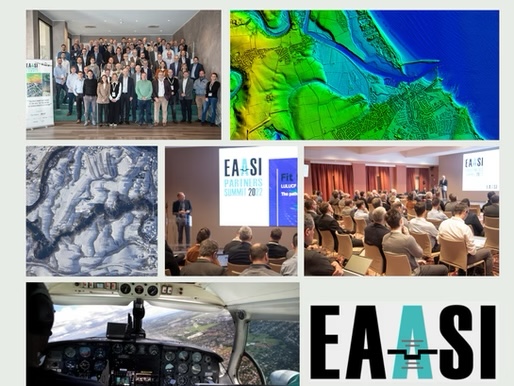
Flai has joined EAASI, the European Association of Aerial Surveying Industries, as an observer.
EAASI's membership is the companies that operate crewed aircraft and aerial surveying equipment across Europe: the people who actually fly the national mapping campaigns. Technology providers like us are welcomed separately, as observers, which is a distinction worth respecting. We do not fly aircraft. We process what comes off them.
What EAASI does for the industry
Aerial surveying is a capital-heavy business spread across a lot of small operators. Aircraft, sensors, crews, certifications and national tender cycles all sit on individual balance sheets, while the conditions that decide whether the work is viable are set somewhere else entirely. No single operator can move those conditions on its own. That gap is the reason an association like this needs to exist, and EAASI fills it well.
Two things they do stand out.
The first is arguing at the right level. When aviation fuel prices rose, EAASI published an open letter framing it not as a private cost problem for survey companies but as a risk to Europe's geospatial data supply. That is the correct framing, and it is not the obvious one. National elevation models, land cover datasets and the update cycles that public administration and infrastructure planning depend on all rest on those flights being economical to fly. Making that dependency visible to the people who set policy is exactly the work a trade association should be doing, and very few organizations in this sector are positioned to do it.
The second is putting the industry in one room. The annual Partners Summit brings operators, sensor and software providers and decision-makers together for several days, which in a fragmented sector is worth more than it sounds. The same logic drives their collective presence at trade events, including a first joint booth at INTERGEO 2026: shared reach that a small operator could not buy alone.
Why we are there
We build the classification models that turn a survey into something a client can use, so what we need to understand is the constraint the operator is under: the flight window, the point density the tender specifies, the deadline, the margin. Those are not things you learn from a spec sheet.
Being in the room as an observer is how we hear about them early, and how we find out which parts of the processing chain are actually costing our industry time. Thanks to the EAASI team for the welcome.